
Fundamentals of Competency Management systems
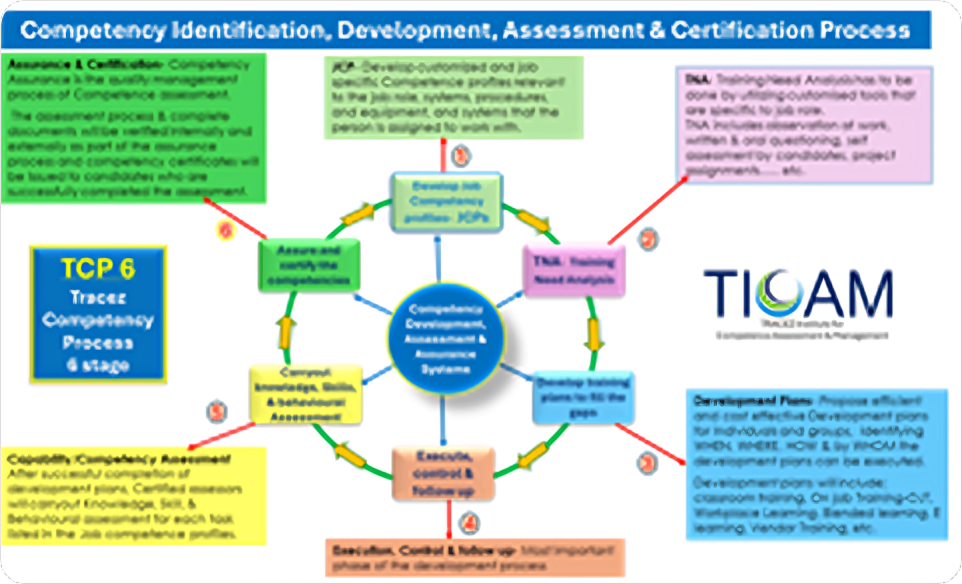
The primary step in a Competency Identification, development, assessment & certification process is the identification of right competencies relevant and specific to the job role. Competencies are unique to each job role and depends up on the job levels, equipment/systems, organisation's business, vision, policies and procedures. This is done by developing JCPs - job competency profiles.
JCPs - Job Competency Profiles
- •Recruitment and selection
- •Training and development
- •Competency assessment
- •Performance evaluation
- •Career progression and succession planning
Competency Levels (Awareness, Knowledge, Skill & Mastery Concept)
Awareness:
Basic understanding on Systems, Processes, Policies and Procedures. Not capable to deliver jobs independently. Awareness is the ability to recognise and understand the purpose, importance, basic concepts, and potential risks associated with a task or process. Individuals at this level are familiar with the activity but are not expected to perform it.
Characteristics
- • Recognises the task and its purpose.
- • Understands basic terminology.
- • Identifies major hazards and safety precautions.
- • Knows where to obtain further information.
- • Understands how the task affects other operations.
Suitable For
- • New employees.
- • Support functions.
- • Personnel indirectly associated with the activity.
- • Visitors and contractors requiring induction.
Knowledge:
Possess sufficient level of understanding. Can perform tasks with support and supervision. Not capable to perform major tasks. Knowledge is the understanding of the technical principles, procedures, standards, and requirements necessary to perform a task. Individuals know how the task should be performed but may not yet have demonstrated practical competence.
Characteristics
- • Understands operating procedures.
- • Knows applicable standards and regulations.
- • Explains equipment functions.
- • Describes process parameters.
- • Understands emergency procedures.
- • Knows causes of common operational problems.
Suitable for
- • Trainees.
- • Senior Engineers, Team Leaders & Managers
- • Supervisors requiring technical knowledge.
- • Employees preparing for practical assessment.
Skill:
Possess good knowledge level. Can perform the activity safely, correctly, and independently in accordance with approved procedures and performance standards.
Characteristics
- • Performs the task independently.
- • Follows procedures accurately.
- • Applies knowledge in real work situations.
- • Identifies and responds to routine problems.
- • Works safely and efficiently.
- • Produces work that meets quality standards.
Suitable For
- • Plant Operators.
- • Maintenance personnel.
- • Inspectors.
- • Specialists
- • First Line supervisors
- • Front-line employees.
Mastery:
Has high level expertise in the area of work. Can handle complex or abnormal situations, optimize performance, coach others, and contribute to continuous improvement. Suitable for Trainers, Assessors, Specialist Coaches, and other similar roles.